If your iPhone camera has stopped focusing properly, refuses to launch certain lenses, or throws errors after a lens replacement, you are not alone. Owners across the Apple Support Community continue to report problems tied to camera lens repair — specifically failures with autofocus, optical image stabilization (OIS), lens switching, and the dreaded “Unable to use Ultra Wide” message that appears after a third-party or even authorized swap.
The complexity of modern iPhone camera modules has turned what used to be a straightforward repair into a serialization-dependent procedure. Replacement lenses must be electronically paired with the logic board, and missing that step is where most post-repair headaches begin. This guide walks through what causes the issue, how to fix it, and when escalating to Apple is your only realistic path forward.
What Causes This Issue
Modern iPhone cameras — from the iPhone 12 Pro onward and especially across the iPhone 14, 15, and 16 series — use tightly integrated modules where the lens assembly, sensor-shift OIS, autofocus actuator, and image signal processor communicate over serialized firmware. A single mismatched component can disable the entire camera stack.
The most common root causes include:
- Parts pairing failure: Apple’s System Configuration tool was not run after the repair, so the new lens assembly is not authenticated to the logic board.
- Damaged flex cables: The ribbon connecting the lens to the main board is fragile. A pinched or torn cable disables autofocus or one lens entirely.
- Magnetized OIS components: High-powered magnets — including MagSafe wallets, motorcycle mounts, and certain car holders — can permanently damage the OIS gimbal.
- Liquid or dust intrusion: Even after the repair, a poorly reseated gasket can let moisture reach the sensor.
- iOS firmware mismatch: After updating iOS, an unpaired lens may suddenly stop working even if it functioned before.
- Aftermarket lens quality: Non-genuine lens assemblies frequently report incorrect focal data, triggering Camera app crashes.
Users in the Apple Support Community consistently note that issues appear immediately after a repair or after an iOS update following a repair — which points firmly at the serialization layer rather than a hardware defect.
Step-by-Step Fixes
- Force-restart the iPhone. Press and release Volume Up, then Volume Down, then hold the Side button until the Apple logo appears. This clears stuck camera daemons and is the single most effective first move.
- Check for an iOS update. Go to Settings, General, Software Update. Apple has shipped multiple point releases in iOS 18 and 19 that re-enable third-party lens components or improve error handling for mismatched parts.
- Toggle camera-related services. Open Settings, Privacy & Security, Camera. Disable access for all apps, restart, then re-enable. This often clears cached lens-identification errors.
- Test in the stock Camera app only. Third-party apps like ProCamera or Halide use direct AVFoundation calls that fail more visibly when a lens is unpaired. If the stock app works but third-party apps do not, the issue is software-side.
- Clean the lens physically. Use a microfiber cloth. Dust trapped under a recently installed lens cover plate causes a hazy image that mimics autofocus failure.
- Remove the case and any MagSafe accessory. Cases with magnetic closures sometimes sit close enough to interfere with the OIS coil. Test the camera without any accessory attached.
- Reset all settings. Settings, General, Transfer or Reset iPhone, Reset, Reset All Settings. This does not erase data but rebuilds the camera configuration profile.
- Run Apple Diagnostics remotely. Contact Apple Support and request a diagnostics session. The technician can confirm whether the lens module is reporting its serial correctly to the logic board.
- Restore via Finder or the Devices app. As a last software step, back up your iPhone, then perform a full restore. If the issue persists after a clean restore, the problem is hardware.
Additional Solutions
Several less-obvious fixes have helped users in the Apple Support Community recover camera functionality:
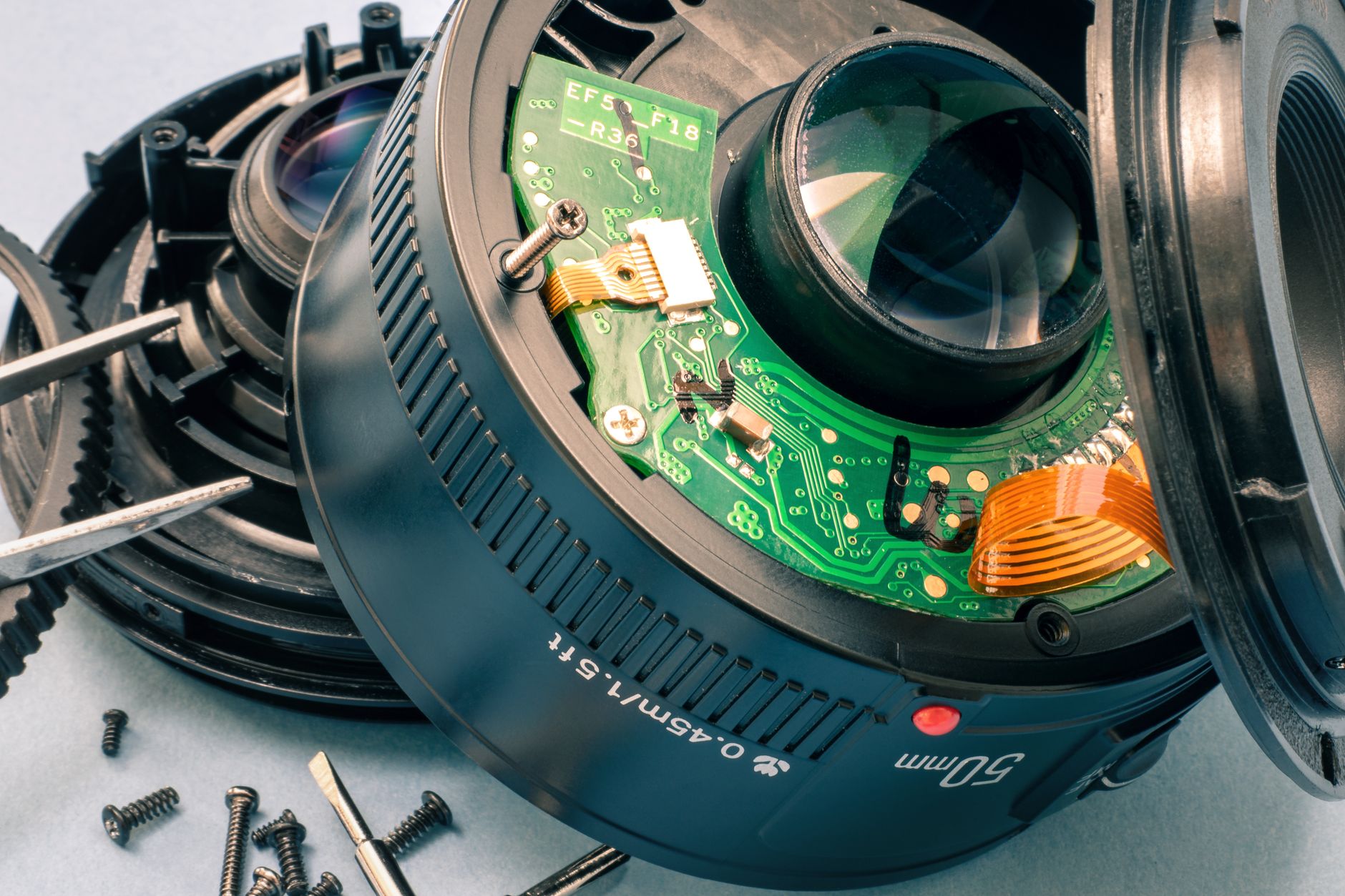
Re-seat the lens connector. If you have the device open, a qualified technician can disconnect and reseat the lens flex cable. Oxidation on the contacts after even minor humidity exposure causes intermittent autofocus.
Demagnetize the OIS assembly. There is no consumer tool for this, but Apple-authorized service providers can swap the affected module. If you suspect magnetization — typically signaled by extreme blurriness or a vibrating sound from the camera — stop using magnetic mounts immediately.
Use Apple’s Self Service Repair program. Apple now offers genuine lens modules through its self-repair portal, along with rental access to the System Configuration tool. This is the only path to a fully paired DIY repair.
Check for water damage indicators. The Liquid Contact Indicator inside the SIM tray slot turns red after exposure. If it has tripped, even a perfectly executed lens repair will not restore camera function until the internal corrosion is addressed.
Disable Lens Correction. Settings, Camera, Lens Correction. On Ultra Wide and front cameras, this software layer can amplify focal-data errors from a mismatched lens. Turning it off sometimes restores usable images.
Check Telephoto-specific settings. On iPhone 15 Pro Max and 16 Pro Max, the tetraprism telephoto module is especially sensitive. If 5x zoom fails but 2x and 3x work, the telephoto assembly likely needs replacement, not repair.
When to Contact Apple Support
Escalate to Apple Support if:
- The Camera app launches but shows a black screen on one or more lenses.
- You receive the “Important Camera Message” warning about a non-genuine part — even after a genuine swap.
- Autofocus hunts continuously and never locks, regardless of lighting.
- The camera worked before an iOS update and stopped immediately after.
- You hear rattling from the camera module — a sign of dislodged OIS components.
Bring the device to an Apple Store or an Apple Authorized Service Provider. If the lens was replaced by an unauthorized shop, Apple will still service the device, though pairing a previously installed non-genuine module is not always possible. Expect to pay out-of-warranty pricing if AppleCare+ has lapsed.
FAQ
Why does my camera show a warning about a non-genuine lens after an authorized repair? The repair technician likely skipped the System Configuration pairing step. Return to the service provider and request that the parts be properly paired through Apple’s Global Service Exchange system.
Can I fix iPhone camera lens issues myself? For iPhone 12 and newer, no — not fully. Even with a genuine replacement lens, you need Apple’s System Configuration tool to authenticate the part. Without pairing, features like Night mode, Deep Fusion, and Smart HDR may be disabled.
Will erasing my iPhone fix camera problems? Only if the issue is software-side. A clean restore rules out misconfigured profiles but cannot resolve a physically damaged lens or unpaired hardware.
How much does an Apple lens repair cost? Out-of-warranty rear camera repairs for recent Pro models typically run between 199 and 249 USD, depending on which lens is affected. AppleCare+ reduces this to a service fee.
Does MagSafe damage iPhone cameras? Genuine MagSafe accessories do not. Aftermarket magnetic mounts — particularly motorcycle mounts that subject the phone to high-frequency vibration combined with strong magnets — have been linked to OIS failure across multiple iPhone generations.