

















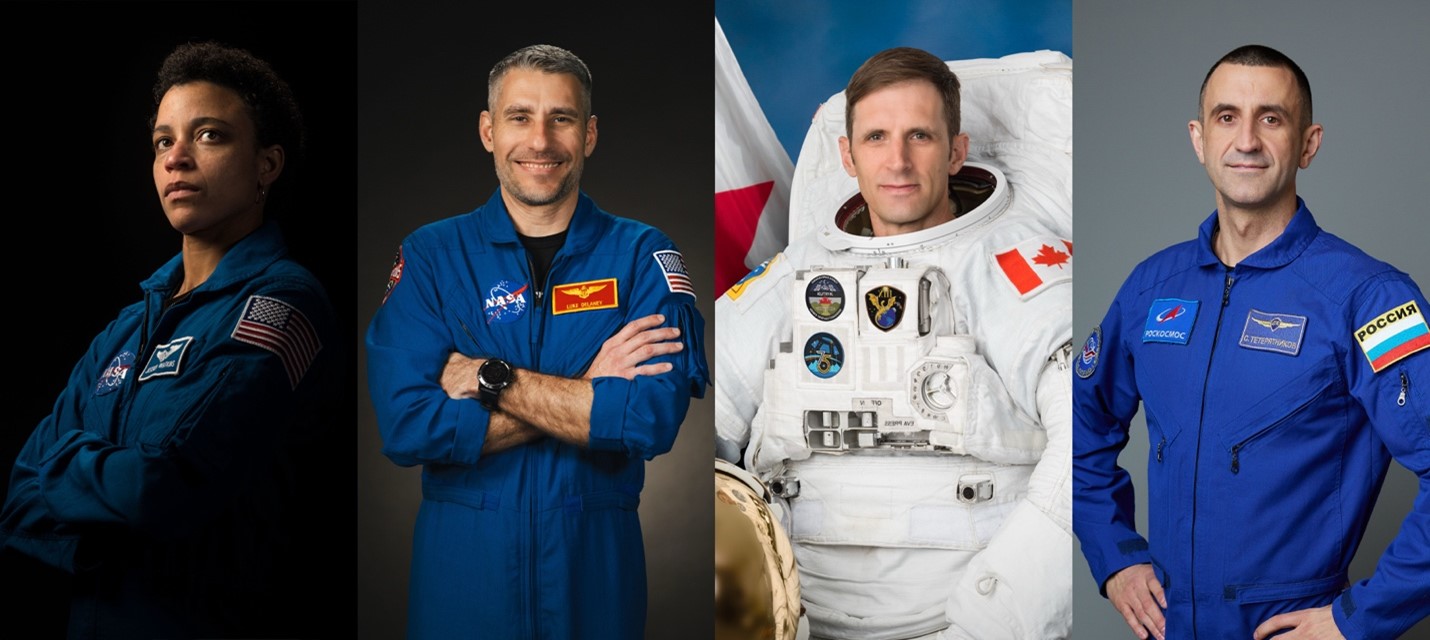
NASA’s SpaceX Crew-13 Mission Set for Mid-September Launch
Nasa is preparing for the launch of its SpaceX Crew-13 mission, scheduled for no earlier than mid-September. This mission will send four astronauts from three different space agencies to the International Space Station (ISS) for a long-duration science expedition. The crew aims to conduct various scientific investigations and technology demonstrations that will aid in future exploration missions to the Moon and Mars.
Crew Composition and Roles
The Crew-13 mission will feature NASA astronauts Jessica Watkins and Luke Delaney, who will serve as spacecraft commander and pilot, respectively. They will be joined by Joshua Kutryk from the Canadian Space Agency (CSA) and Sergey Teteryatnikov from Roscosmos, both of whom will act as mission specialists. Upon arrival at the ISS, Crew-13 will integrate into Expedition 75, contributing to ongoing research aboard the orbiting laboratory.
Advancements in NASA’s Commercial Crew Program
This flight marks the 13th crew rotation under NASA’s Commercial Crew Program, a partnership with SpaceX aimed at increasing the frequency of U.S. crewed missions to the ISS. In a strategic move, NASA has advanced the launch date of Crew-13 from November to September. This adjustment is intended to boost the cadence of crew rotations, thereby enhancing scientific output and operational efficiency aboard the space station.
Profiles of the Astronauts
Jessica Watkins is no stranger to space missions; this will be her second flight to the ISS. Selected as a NASA astronaut in 2017, she has an impressive educational background that includes a degree in geological and environmental sciences from Stanford University and a doctorate in geology from UCLA. Watkins previously participated in NASA’s SpaceX Crew-4 mission, spending 170 days in space during Expeditions 67/68 in 2022. Notably, she will become the first NASA astronaut to launch aboard a SpaceX Dragon spacecraft twice.
Luke Delaney, also selected as a NASA astronaut in 2021, is making his inaugural spaceflight with Crew-13. A Florida native, he holds a bachelor’s degree in mechanical engineering and a master’s degree in aerospace engineering. Delaney has an extensive background as a naval aviator and test pilot, having evaluated developmental aircraft systems before transitioning to research pilot roles at NASA’s Langley Research Center.
Joshua Kutryk brings his own unique experience as this mission marks his first journey into space. Before joining CSA as an astronaut in 2017, he served as a CF-18 fighter pilot and worked on various test pilot projects after earning his mechanical engineering degree from the Royal Military College of Canada. His academic credentials include multiple master’s degrees related to aerospace studies.
Sergey Teteryatnikov rounds out the crew with his debut flight to the ISS. A graduate of Russia’s Naval Academy specializing in ship power plant operations, he has held various naval engineering roles before being selected for cosmonaut training at the Gagarin Research and Test Cosmonaut Training Center in 2021.
The Importance of Continuous Research on the ISS
The International Space Station has been continuously inhabited for over 25 years, serving as a platform for groundbreaking scientific research that cannot be conducted on Earth. The station plays a crucial role in helping NASA understand human spaceflight challenges while expanding commercial opportunities in low Earth orbit (LEO). The ongoing research conducted aboard the ISS lays vital groundwork for future long-duration missions under NASA’s Artemis program aimed at returning humans to the Moon and eventually sending them to Mars.
What This Means
The upcoming Crew-13 mission underscores NASA’s commitment to advancing human space exploration through international collaboration and commercial partnerships. By accelerating crew rotations and enhancing scientific endeavors aboard the ISS, this mission not only prepares astronauts for future lunar and Martian expeditions but also contributes valuable knowledge that can benefit life on Earth. As these astronauts embark on their journey, they carry with them hopes for new discoveries that could shape humanity’s future beyond our planet.
For more information, read the original report here.