
























NASA’s James Webb Space Telescope Reveals Surprising Insights from Interstellar Comet 3I/ATLAS
In December 2025, astronomers seized a unique opportunity to study interstellar comet 3I/ATLAS as it moved away from the Sun. Utilizing NASA’s James Webb Space Telescope (JWST), researchers captured detailed measurements of the comet’s chemical components, revealing unexpected findings that could reshape our understanding of its origins and the conditions in the early universe.
A Closer Look at Comet 3I/ATLAS
Comet 3I/ATLAS is notable for being the third confirmed interstellar comet, indicating it originated outside the solar system. Its name derives from the ATLAS (Asteroid Terrestrial-impact Last Alert System), which first detected it. The JWST’s observations were particularly timely, as the comet had just passed close to the Sun, causing its ancient ice to vaporize into a bright coma of gas, making it ideal for analysis.
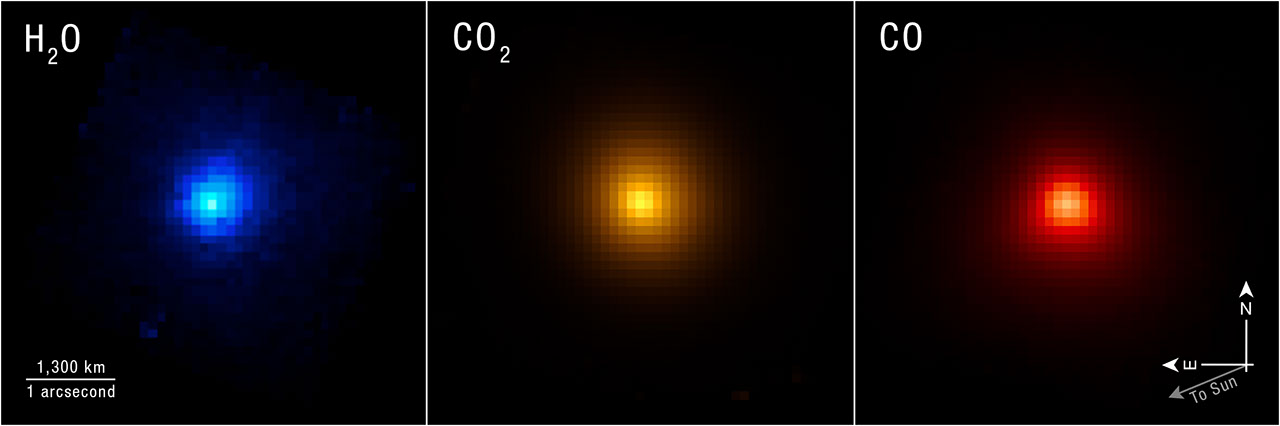
The research team utilized JWST’s Near-Infrared Spectrograph (NIRSpec) to map specific chemical contents of 3I/ATLAS. They discovered exceptionally high levels of deuterium (a heavier isotope of hydrogen), approximately 30 times more than typically found in solar system comets. This significant finding suggests that 3I/ATLAS may have formed in a much colder environment earlier in the galaxy’s history.
Unexpected Chemical Ratios
The analysis revealed surprising ratios of carbon and deuterium that differ markedly from those found in comets within our solar system. For instance, NIRSpec data showed only traces of carbon-13 compared to carbon-12. This discrepancy indicates that 3I/ATLAS likely formed in an ancient stellar system that had not yet undergone extensive stellar evolution, which enriches systems with heavier isotopes like carbon-13 over time.
According to Martin Cordiner, an astro-chemist at NASA’s Goddard Space Flight Center and lead author of the study, “This was a unique opportunity to study an ancient object from a distant galaxy, probably pre-dating our Sun and solar system.” This insight allows researchers to glean information about both the conditions under which 3I/ATLAS formed and how these conditions compare to those in our own solar system.
Implications for Understanding Prebiotic Chemistry
The findings from JWST are complemented by a separate study conducted using the European Southern Observatory’s Very Large Telescope. This additional research analyzed 3I/ATLAS’s carbon and nitrogen isotopes in the form of cyanide. The combined studies provide a more comprehensive picture of the comet’s chemical makeup.
Stefanie Milam, co-author of the study with Cordiner, emphasized the broader implications of these findings: “For us as scientists, finding these rare isotopes is fascinating, but the bigger picture here is looking at the possibilities of prebiotic chemistry elsewhere in the galaxy.” Current knowledge indicates that Earth is unique in hosting life; thus, understanding other celestial bodies’ chemical compositions may reveal how common or rare life-supporting conditions are throughout the universe.
The Significance of Webb’s Observations
The James Webb Space Telescope continues to be an invaluable asset in unraveling cosmic mysteries. Its advanced capabilities allow scientists to probe distant worlds and investigate fundamental questions about our universe. The observations made during this study not only enhance our understanding of interstellar comets but also contribute significantly to astrobiology—the study of life’s potential beyond Earth.
The research team’s estimates suggest that 3I/ATLAS could have formed between 10 to 12 billion years ago during a period known as “cosmic noon,” when star formation peaked across the universe. This timeline positions it as one of the oldest objects observed by modern telescopes, providing a rare glimpse into conditions prevalent during early cosmic history.
What This Means for Future Research
The insights gained from studying comet 3I/ATLAS underscore how interstellar objects can serve as windows into our galaxy’s past. By analyzing their compositions, scientists can better understand not only where these objects came from but also how they relate to planetary systems like our own. As more data becomes available through continued observations with JWST and other telescopes, researchers hope to uncover even more about the origins of life and its potential existence elsewhere in the cosmos.
For more information, read the original report here.