

















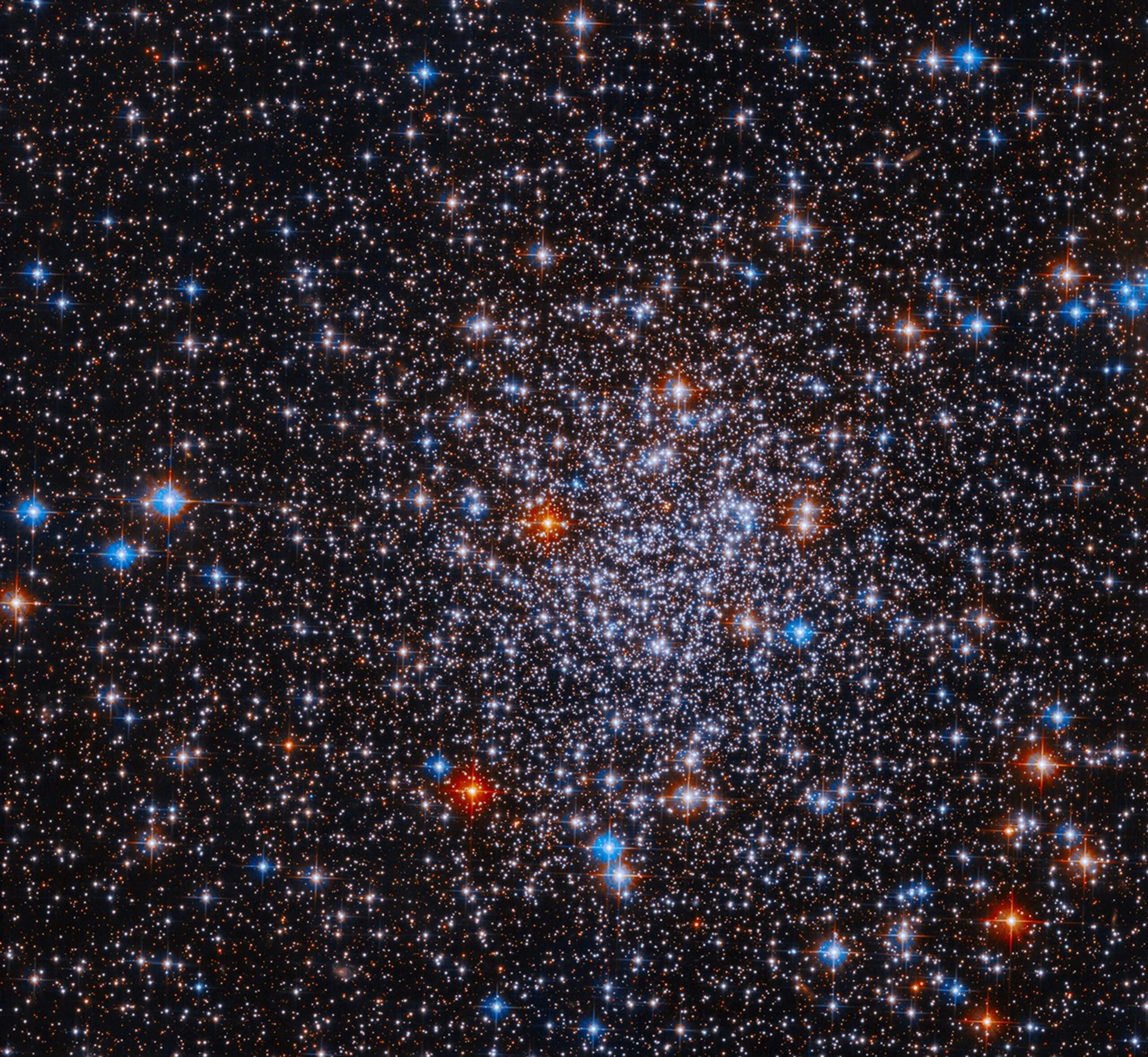
In a remarkable display of cosmic beauty, NASA’s Hubble Space Telescope has captured an awe-inspiring image of a previously unexplored globular cluster, known as ESO 591-12 or Palomar 8. This celestial spectacle, brimming with multicolored stars, offers a glimpse into one of the universe’s most fascinating phenomena.
Understanding Globular Clusters
Globular clusters are extraordinary celestial formations consisting of tens of thousands to millions of stars. These stars are bound together by gravity, forming a spherical shape that often resembles a glittering, cosmic snow globe. What makes these clusters particularly intriguing is their age and composition. They generally form during the early stages of a galaxy’s history, in regions teeming with gas and dust. The stars within a globular cluster often share a similar age, having formed from the same collapsing cloud of gas.
In the stunning image of ESO 591-12, a variety of red and blue stars are scattered across the cluster. These colors are indicative of the stars’ temperatures, with red stars being cooler and blue stars being hotter. This color variance offers a visual clue to the diversity of stellar temperatures within the cluster.
Hubble’s Role in Unveiling Celestial Secrets
The data used to create this mesmerizing image was collected by the Hubble Space Telescope as part of a comprehensive study. This study aims to resolve individual stars within the entire globular cluster system of the Milky Way. Before Hubble, ground-based telescopes struggled to distinguish individual stars in such densely packed clusters. However, Hubble’s advanced capabilities have revolutionized the study of globular clusters, providing unprecedented clarity and detail.
This particular study is part of the Hubble Missing Globular Clusters Survey. The survey targets 34 confirmed Milky Way globular clusters that Hubble has not yet observed. The program seeks to deliver complete observations of the ages and distances of all globular clusters within our galaxy. Additionally, it aims to investigate fundamental properties of yet-to-be-explored clusters located in the galactic bulge or halo.
Significance of the Study
Understanding globular clusters is crucial for astronomers as they offer valuable insights into the early stages of our galaxy’s formation. By studying these clusters, scientists can gather key information about the conditions and processes that occurred during the Milky Way’s infancy. This, in turn, helps improve our understanding of galaxy formation and evolution as a whole.
The observations conducted by Hubble are expected to provide a treasure trove of data that will aid in unraveling the mysteries of our galaxy’s past. By examining the ages and distances of globular clusters, astronomers can piece together a more comprehensive picture of the Milky Way’s history and structure.
Technical Insights for the Layman
For those unfamiliar with astronomical terms, let’s break it down in simple terms:
- Globular Clusters: Imagine a tightly packed ball of stars, thousands to millions of them, all held together by gravity. These clusters are some of the oldest objects in the universe.
- Hubble Space Telescope: This is a powerful telescope orbiting the Earth, designed to capture detailed images of distant celestial objects. It has transformed our understanding of the universe by providing clear and detailed views of cosmic phenomena.
- Galactic Bulge and Halo: The galactic bulge is the central, densely packed region of a galaxy, while the halo is the outer area. These regions contain many globular clusters, which are being studied to learn more about the galaxy’s history.
Reactions and Reviews
The revelation of this image and the associated study has sparked excitement and intrigue within the astronomical community. Researchers and enthusiasts alike are eager to delve into the data provided by this survey. The potential to uncover new insights into the formation and evolution of our galaxy is a tantalizing prospect.
By studying clusters like ESO 591-12, astronomers hope to answer questions about the conditions that led to the formation of globular clusters and their role in the broader context of galactic development. This research not only enriches our understanding of the cosmos but also deepens our appreciation for the intricate beauty and complexity of the universe.
Concluding Thoughts
The Hubble Space Telescope continues to be an invaluable tool in the quest to explore and understand the universe. Its ability to capture detailed images of previously unobserved globular clusters like ESO 591-12 allows scientists to push the boundaries of our knowledge and explore the mysteries of the cosmos.
As we stand on the precipice of new discoveries, the study of globular clusters offers a unique opportunity to connect with the past and unravel the secrets of our galactic origins. The vibrant image of ESO 591-12 is a testament to the wonders of the universe and a reminder of the endless possibilities that lie within the stars.
For those interested in further exploring the details of this study, additional resources and research findings can be accessed through NASA’s official website at NASA Hubble. Here, one can delve deeper into the world of astronomy and gain a greater appreciation for the scientific endeavors that continue to expand our understanding of the cosmos.
For more Information, Refer to this article.