























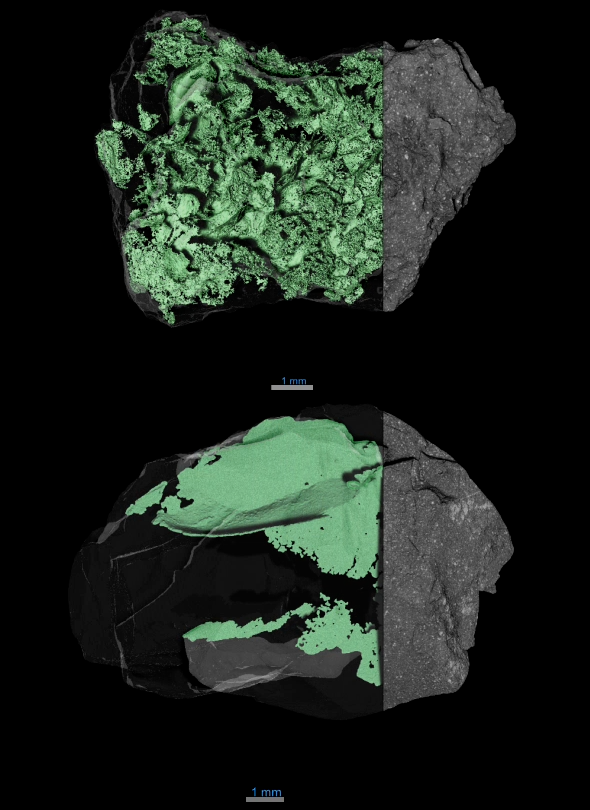
The recent release of X-ray computed tomography (XCT) scans on March 17, 2026, has provided valuable insights into the composition of asteroid Bennu. These scans have revealed the presence of common crack networks within Bennu samples, shedding light on a long-standing mystery that has puzzled NASA scientists for years.
When NASA’s OSIRIS-REx spacecraft first approached asteroid Bennu in 2018, researchers were taken aback by the unexpected discovery of a surface covered in boulders, rather than the smooth, sandy beaches they had anticipated. This stark contrast was particularly surprising given the low thermal inertia measured by NASA’s Spitzer Space Telescope in 2007, which suggested that Bennu’s surface should exhibit properties similar to a sandy beach on Earth.
The discrepancy between the thermal properties observed from afar and the actual rocky terrain encountered by OSIRIS-REx raised questions about the composition of Bennu’s surface. Data collected during the spacecraft’s survey campaign at the asteroid hinted at a possible explanation: the boulders on Bennu might be more porous than initially assumed. This hypothesis was further explored once samples from Bennu were returned to Earth for analysis.
The XCT scans released by NASA have played a crucial role in unraveling the mystery surrounding Bennu’s composition. By providing detailed images of the crack networks present in the asteroid samples, these scans have offered valuable insights into the porous nature of Bennu’s boulders. This information has helped reconcile the discrepancies between the expected sandy surface and the rocky reality observed on Bennu.
The findings from these XCT scans have significant implications for our understanding of asteroids and their composition. By uncovering the presence of porous boulders on Bennu, scientists have gained a deeper insight into the processes that shape these celestial bodies. This knowledge not only enhances our understanding of Bennu specifically but also contributes to our broader understanding of the formation and evolution of asteroids in our solar system.
Overall, the release of these XCT scans marks a significant milestone in our exploration of asteroid Bennu. By utilizing advanced imaging techniques, researchers have been able to unlock valuable information about the composition of this enigmatic celestial body. The insights gained from these scans not only address long-standing mysteries but also pave the way for further research and discoveries in the field of planetary science.
As we continue to delve deeper into the mysteries of our solar system, the revelations from the XCT scans of asteroid Bennu serve as a reminder of the endless wonders that await us in the vast expanse of space. Through continued exploration and scientific inquiry, we can unlock the secrets of the universe and broaden our understanding of the cosmic phenomena that surround us.
Image credit: NASA/Scott Eckley
For more Information, Refer to this article.