New Insights into Earth’s Early Element Acquisition
NASA-supported scientists have unveiled significant findings regarding how early Earth may have obtained essential elements for life, particularly nitrogen and phosphorus. Published in the journal Science Advances, the study sheds light on the roles of various celestial bodies in the distribution of these vital elements during the formation of the solar system over 4.5 billion years ago.
The Formation of Our Solar System
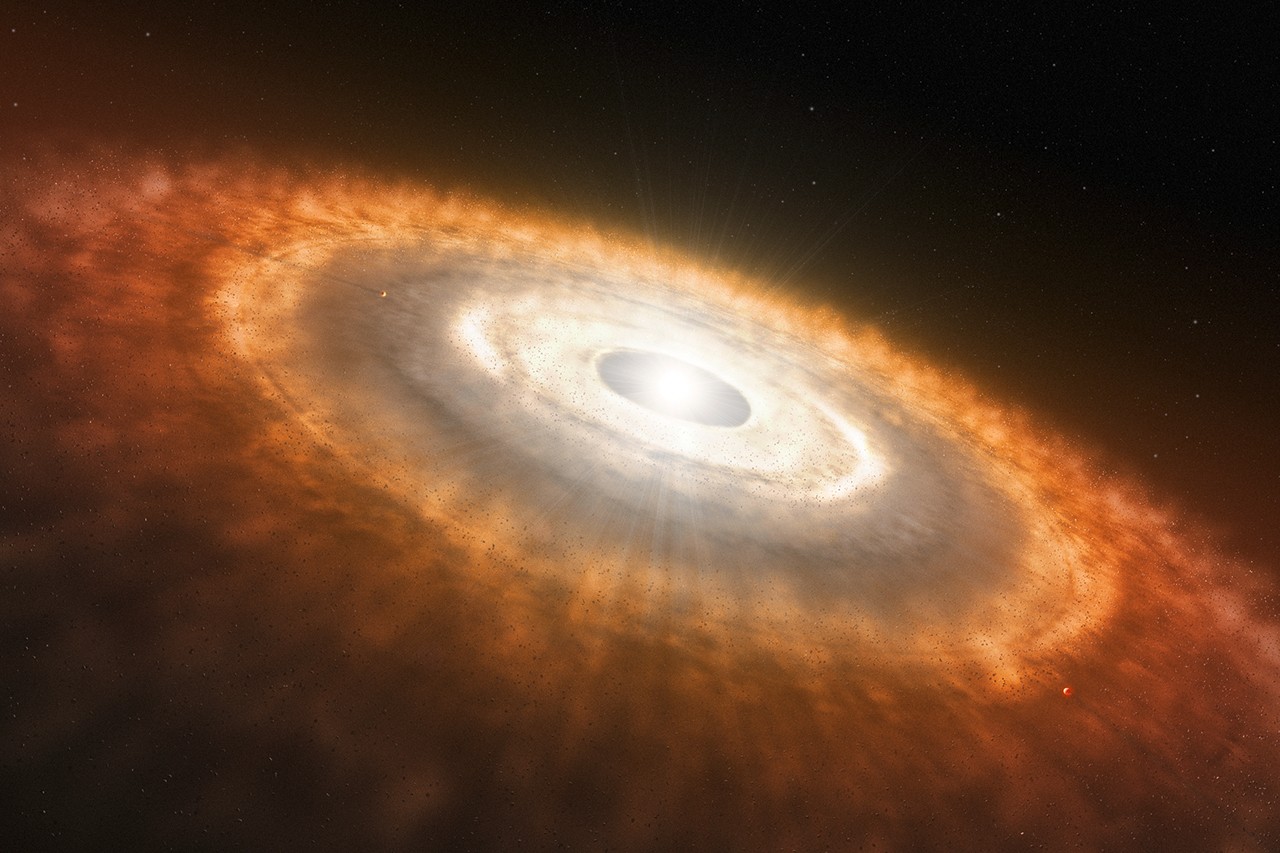
The solar system originated from a swirling cloud of gas and dust surrounding the proto-Sun, which contained the building blocks necessary for planetary formation. Among these building blocks, nitrogen and phosphorus stand out as critical components for life as we know it. In its infancy, the solar system was a chaotic environment where gas and dust coalesced into planetesimals—small celestial bodies that would eventually collide and form larger planets and moons.
As planetesimals orbited the young Sun, they underwent numerous collisions, leaving behind remnants that would later become asteroids or meteorites. These meteorites serve as valuable time capsules, offering insights into the early solar system before Earth came into existence. The two primary types of meteorites relevant to this study are iron meteorites and chondrites. Iron meteorites are dense metallic objects primarily composed of iron-nickel alloy, while chondrites are stony meteorites that account for most finds on Earth.
Examining Element Ratios in Meteorites
The research team focused on understanding how Earth accumulated life-essential elements by analyzing the phosphorus-to-nitrogen (P/N) ratios in iron meteorites and chondrites. Understanding the timing and sources of these elements is crucial for astrobiologists studying when Earth became habitable.
There has been ongoing debate among scientists regarding where Earth’s supply of nitrogen and phosphorus originated. Some theories suggest that chondrites from the outer solar system migrated inward to contribute to Earth’s elemental inventory late in its formation process. However, this new study presents an alternative perspective.
Through laboratory experiments and geochemical modeling, researchers reconstructed a map illustrating P/N ratios across different regions of the early solar system. They discovered that first-generation planetesimals (the sources of iron meteorites) exhibited higher P/N ratios in the outer solar system compared to their second-generation counterparts (the sources of chondrites), which had higher ratios closer to the Sun.
The Role of Jupiter in Element Distribution
The study posits that during the formation of first-generation planetesimals, there was an outward flow of materials that elevated P/N ratios in the outer regions. The emergence of Jupiter played a pivotal role in shaping this distribution. As Jupiter grew larger and exerted significant gravitational influence, it restricted the movement of phosphorus and nitrogen from inner to outer regions of the solar system.
This gravitational barrier meant that when second-generation planetesimals formed, those located closer to the Sun retained higher P/N ratios than those farther out. Rajdeep Dasgupta from Rice University emphasized Jupiter’s critical role: “For our own solar system, Jupiter’s presence and growth history seem to have played a crucial role in determining the distribution of basic chemical ingredients necessary for habitable worlds.” He also raised an intriguing question about whether a similar inventory of life-essential elements could exist without a Jupiter-like planet.
Implications for Understanding Earth’s Composition
Further geochemical modeling indicated that Earth’s current P/N signature aligns more closely with materials from inner solar system planetesimals rather than relying heavily on contributions from outer solar system chondrites. Debjeet Pathak, lead author of the study, remarked that “the study suggests that Earth acquired its inventory of life-essential elements primarily from the inner solar system.” This finding challenges previous assumptions about how these critical ingredients reached our planet.
What This Means
This research provides valuable insights into not only how Earth became habitable but also how planetary systems may evolve elsewhere in the universe. By understanding Jupiter’s influence on elemental distribution, scientists can refine their models regarding planetary formation and habitability criteria beyond our own solar system. As researchers continue to explore these cosmic processes, they may uncover further implications for life’s potential existence on other planets.
For more information, read the original report here.