























NVIDIA Showcases AI Innovations for Climate Science on Earth Day
On Earth Day, NVIDIA highlighted five groundbreaking projects that leverage artificial intelligence (AI) and accelerated computing to enhance climate science and sustainability efforts. These initiatives aim to transform traditional environmental monitoring and conservation methods, making them more efficient and effective in addressing pressing ecological challenges.
Advancements in Climate Simulation: NVIDIA Earth-2
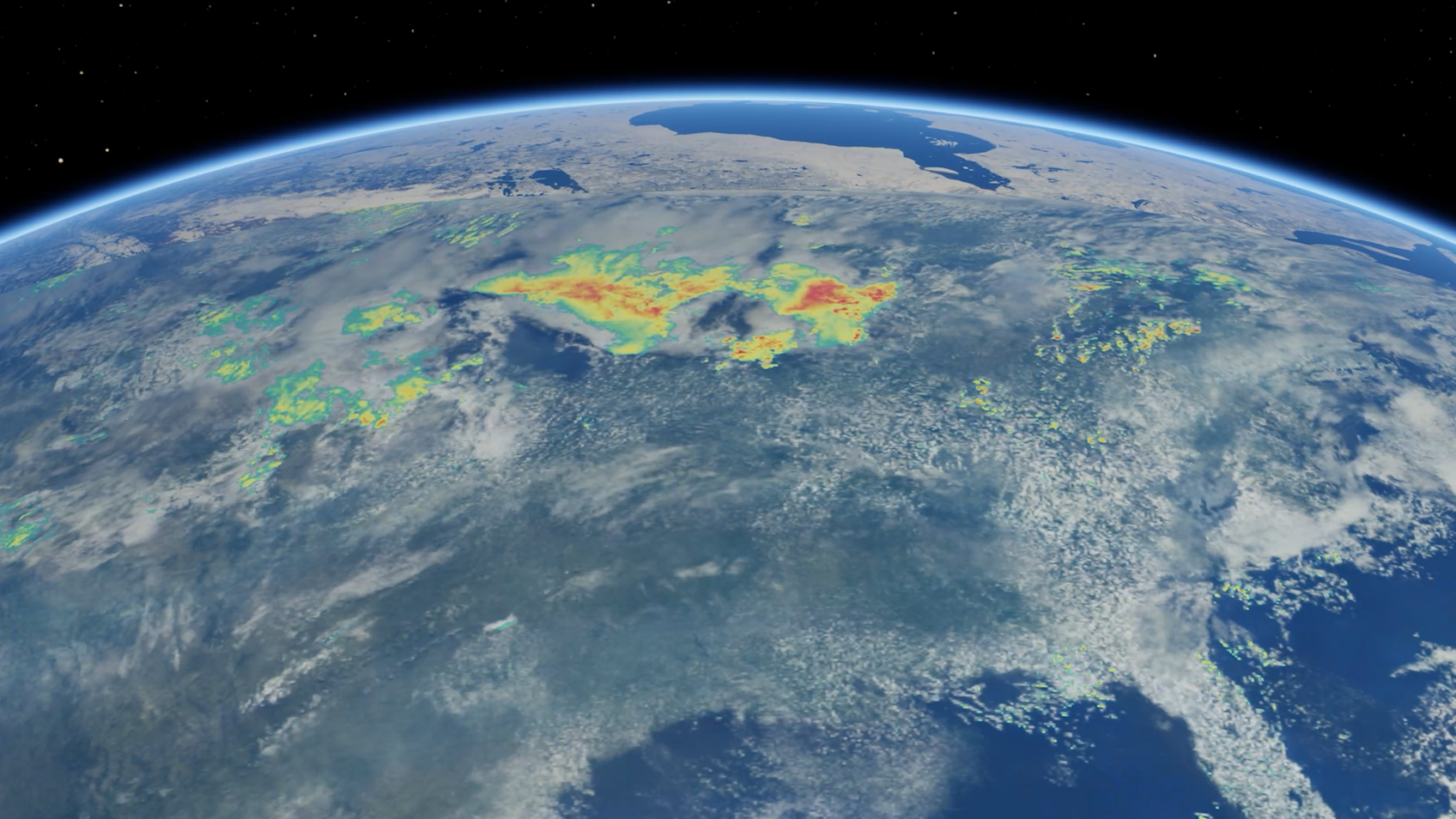
NVIDIA is at the forefront of climate simulation with its Earth-2 initiative, which encompasses a family of open AI models, libraries, and frameworks. This marks the world’s first fully open, accelerated weather AI software stack designed to enhance weather and climate understanding.
Earth-2 optimizes all phases of weather prediction, from processing initial observational data to generating comprehensive forecasts. Notably, the Earth-2 Nowcasting model utilizes generative AI to convert country-scale forecasts into high-resolution predictions of local storms within minutes. This capability allows for zero- to six-hour forecasts that are crucial for timely disaster response.
Another significant component is the Earth-2 Global Data Assimilation model, which can be downloaded from platforms like Earth2Studio and Hugging Face. This model addresses the substantial computational demands faced by forecasters, particularly in preprocessing raw observational data. With the ability to run on a single GPU (graphics processing unit), it transforms this raw data into global atmospheric snapshots in mere minutes. Developed in collaboration with the National Oceanic and Atmospheric Administration (NOAA) and MITRE, this model significantly enhances forecasting efficiency.
AI Enhancing Wildlife Conservation Efforts
The application of AI in wildlife conservation is proving transformative, particularly for critically endangered species like orangutans. Recent studies conducted in Borneo and Sumatra have demonstrated how GPU-accelerated AI can automate the detection of orangutan nests from aerial imagery. This advancement drastically reduces both time and costs associated with population monitoring.
Traditionally, counting orangutan nests required labor-intensive field surveys that could only cover about one kilometer per hour. In contrast, drone surveys can capture imagery over 18 kilometers within the same timeframe. However, manual analysis of these images posed a bottleneck; experts would need approximately one minute per image for nest identification. The new AI models trained on NVIDIA GPUs can process 1,800 images in under five minutes, streamlining this critical conservation task.
One study published in the American Journal of Primatology revealed that an AI model achieved over 99% accuracy in classifying aerial images as containing nests or not. This efficiency allows researchers to focus on broader conservation strategies rather than getting bogged down in tedious image analysis.
Revolutionizing Recycling with Smarter Sorting Technologies
The recycling industry faces significant challenges related to cost and efficiency. Conventional sorting facilities often miss up to 25% of recoverable materials despite hefty investments. AMP, part of NVIDIA’s Inception startup program focused on sustainable futures, is addressing these issues through innovative AI-driven solutions.
AMP has developed advanced robotics systems that not only enhance sorting capabilities at existing recycling sites but also facilitate the construction of entirely automated recycling facilities. Their operations have successfully diverted over 2 billion pounds of material from landfills since inception, preventing approximately 739,000 metric tons of carbon-dioxide-equivalent emissions.
The company boasts a remarkable recovery rate of 90%, significantly higher than the typical 75% achieved by traditional plants. By employing NVIDIA Hopper GPUs, AMP has halved energy consumption during AI inference processes while simultaneously optimizing sorting speed and efficiency.
Improving Tsunami Early Warning Systems
Researchers are developing advanced tsunami early warning systems capable of providing timely alerts before catastrophic waves strike coastal areas. Current systems rely on simplified models that can lead to delayed or inaccurate warnings; however, a new approach aims to rectify this issue by solving complex inverse problems using pressure readings from seafloor sensors.
A collaborative team from UT Austin and Lawrence Livermore National Laboratory has created a method that allows for rapid computation following a seismic event. By precomputing wave equations for various scenarios and utilizing GPU technology, they have achieved a speedup factor of up to 10 billion times compared to existing methods. This innovation could provide crucial life-saving minutes for coastal residents during an imminent tsunami threat.
AI-Powered Earth Observation: Planet’s Initiative
Planet operates the largest constellation of Earth observation satellites globally, with a mission to capture daily images of the entire planet. However, processing raw satellite data into actionable insights typically takes hours due to extensive computational requirements.
A recent collaboration between Planet and NVIDIA has led to significant advancements in this area by creating a GPU-native pipeline that dramatically accelerates data processing times—from hours down to seconds for delivering critical wildfire insights—enabling quicker responses by first responders during emergencies.
What This Means
The integration of AI into environmental science represents a paradigm shift in how researchers monitor ecosystems and respond to climate-related challenges. From enhancing forecasting accuracy with Earth-2 models to revolutionizing wildlife conservation efforts through automated nest detection and improving recycling efficiencies with smart sorting technologies—these innovations underscore the potential for technology-driven solutions in safeguarding our planet’s future. As these projects continue to evolve, they promise not only enhanced operational efficiencies but also greater impact on global sustainability efforts.
For more information, read the original report here.