NVIDIA Advances Robotics Research at ICRA 2023
NVIDIA has unveiled significant advancements in robotics research during the International Conference on Robotics and Automation (ICRA) 2023, showcasing eight of its 28 accepted papers. These studies highlight the transition from controlled demonstrations to reliable, generalizable embodied autonomy, emphasizing the importance of simulation-to-real transfer for enabling robots to navigate dynamic and unpredictable environments.
Enhancing Coordination and Navigation
One of the key challenges in robotics is coordinating multiple robotic arms to perform complex tasks simultaneously. Traditional scheduling methods often handle these tasks sequentially, limiting efficiency. NVIDIA’s ScheduleStream framework addresses this issue by leveraging GPU computations, allowing multiple arms to plan and execute movements in parallel. This innovation results in a threefold increase in speed for multi-arm planning scenarios on platforms like NVIDIA’s Jetson edge AI system.
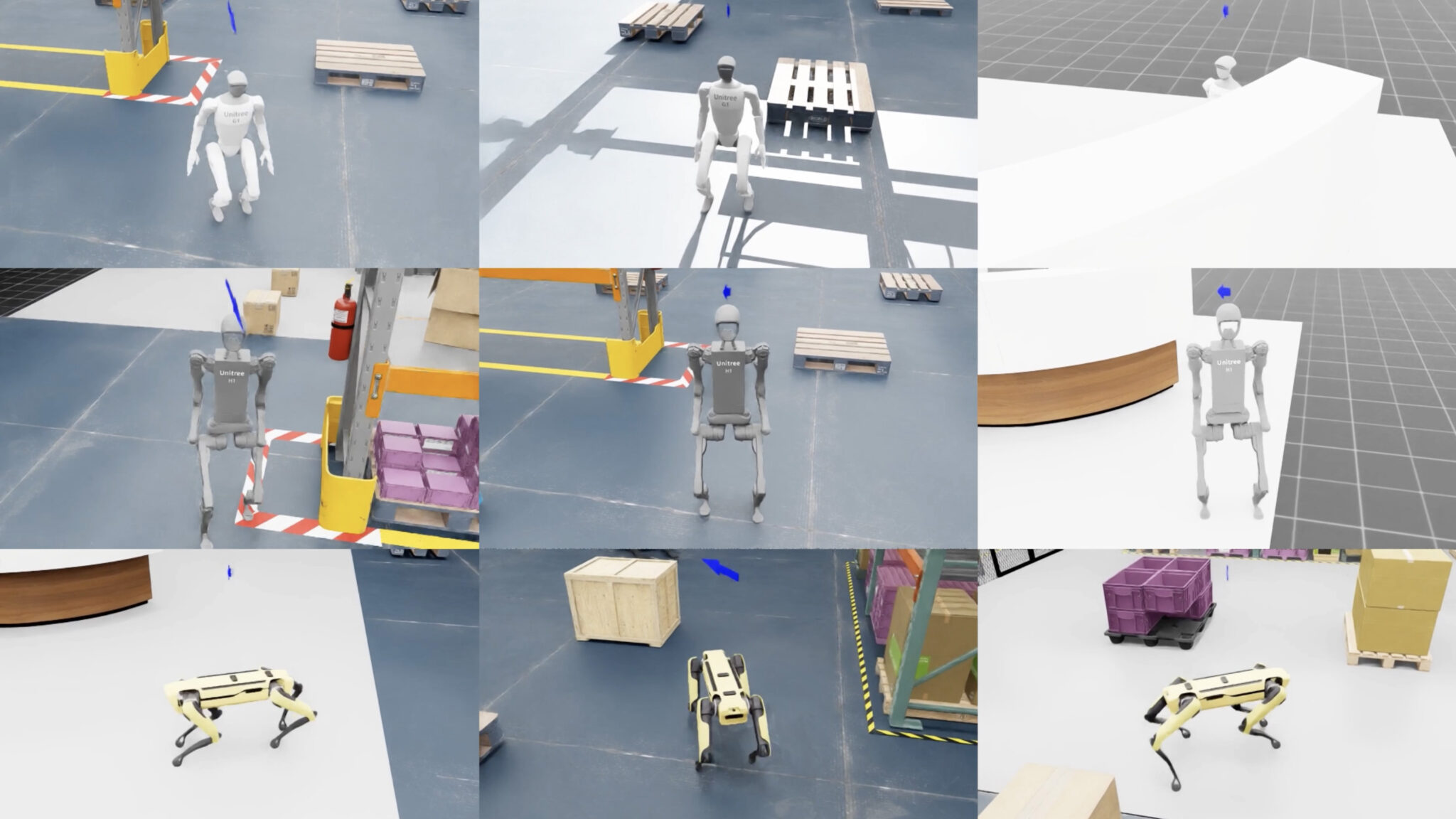
Another challenge is enabling robots to navigate effectively across different body types. The COMPASS policy framework tackles this by initially establishing navigation capabilities through imitation learning, followed by reinforcement learning to adapt to various robot embodiments. Notably, this approach does not require real-world data; all training occurs within the NVIDIA Isaac Lab simulation environment. COMPASS has demonstrated a 4.5 times improvement in success rates compared to traditional methods, achieving approximately 80% success across real-world navigation trials with autonomous mobile robots and humanoids.
Innovations in Grasping and Manipulation
Robotic grasping systems typically follow a fixed plan from identification to execution, which can lead to errors during the critical final approach. The Grasp-MPC framework revolutionizes this process by adaptively computing grasps and continuously correcting motion as the robot approaches an object. This method was trained on two million simulated trajectories across 8,000 objects and has achieved a 75% success rate in real-world scenarios, significantly outperforming traditional baselines.
The Deformable Cluster Manipulation framework further expands robotic capabilities by enabling systems to grasp multiple flexible objects simultaneously. This technique was inspired by practical applications such as clearing tangled branches from power lines. By employing biological growth equations to generate synthetic training data, this framework allows robots to manipulate complex clusters without prior specific training on real-world objects.
Precision Assembly Techniques
Assembly tasks pose unique challenges due to the complexities of real-world environments that simulations often overlook. The SPARR method addresses these issues by dividing assembly tasks into two phases: initial strategy learning in simulation followed by real-time adjustments based on sensory feedback from the robot’s camera. This dual-layer approach has led to a 38% improvement in success rates and reduced cycle times by approximately 30% compared to traditional zero-shot methods.
The Refinery framework takes assembly a step further by managing multi-step processes where each step’s outcome influences subsequent actions. By training across various simulated scenarios, Refinery achieves a remarkable 91% success rate in simulations and nearly an 11% improvement in real-world applications over comparable methods.
Vision-Language Models for Enhanced Task Execution
NVIDIA’s PEEK pipeline introduces an innovative way for robots to focus on relevant information during manipulation tasks. By utilizing vision-language models that interpret task instructions, PEEK enables robots to prioritize their attention on essential objects while filtering out distractions. This approach has resulted in up to a 41-fold increase in accuracy for policies trained solely in simulation.
The SEAL method enhances task execution reliability by ensuring that robots not only reason through their actions but also execute them accurately. By generating multiple candidate action sequences and evaluating their potential outcomes at runtime, SEAL improves accuracy by up to 15%, even when faced with variations such as rephrased instructions or changes in scene conditions.
Collaborative Efforts and Future Directions
NVIDIA is expanding its commitment to robotics research through large-scale open datasets aimed at fostering innovation within the field. The NVIDIA Physical AI Dataset has become one of the most downloaded resources for physical development research, facilitating advancements across various robotics applications.
Universities such as Carnegie Mellon University (CMU), ETH Zurich, MIT, and the University of Texas at Austin are leveraging NVIDIA technologies to transition physical AI research from simulation into practical applications. Nearly 50 papers presented at ICRA referenced NVIDIA-accelerated simulation and robot learning techniques, underscoring the growing collaboration between academia and industry.
What This Means
The advancements showcased at ICRA 2023 signify a pivotal moment for robotics research as it moves closer toward practical applications beyond controlled environments. With innovations like ScheduleStream, COMPASS, Grasp-MPC, SPARR, Refinery, PEEK, and SEAL paving the way for more capable autonomous systems, industries can expect more efficient automation solutions that can operate reliably in unpredictable real-world settings.
For more information, read the original report here.