






























HashiCorp Introduces Envelope Encryption for Vault Transit
HashiCorp has announced a significant enhancement to its Vault Transit secrets engine, introducing an SDK that enables envelope encryption. This new capability allows applications to encrypt and decrypt large datasets locally while Vault manages cryptographic keys and access policies. This development addresses performance bottlenecks associated with traditional encryption methods, particularly for large artifacts and streaming data.
The Challenge of Traditional Encryption Models
Vault’s Transit secrets engine has long provided a robust encryption-as-a-service solution, allowing applications to encrypt sensitive data without the need for direct management of cryptographic keys. In this model, applications send data to Vault for encryption and receive the ciphertext in return. While effective for small objects like tokens and secrets, this approach becomes cumbersome when dealing with larger datasets.
Transferring large payloads to Vault introduces performance issues and unnecessary network overhead, creating bottlenecks that can hinder application efficiency. To overcome these challenges, HashiCorp’s new SDK facilitates envelope encryption, enabling local encryption and decryption operations while maintaining centralized key management through Vault.
Understanding Envelope Encryption
Envelope encryption is an industry-standard method designed to simplify the encryption of large datasets and high-volume data streams. Rather than encrypting entire datasets with a centralized service, this approach separates data encryption from key management.
In the envelope encryption model:
- A data encryption key (DEK) is generated for each artifact.
- The DEK is then encrypted using a Transit key managed by Vault.
- The encrypted DEK (EDK) is stored alongside the encrypted data.
This structure allows applications to perform actual encryption and decryption operations locally while Vault retains responsibility for managing keys and enforcing access control policies.
How Envelope Encryption Works
The workflow for envelope encryption consists of two primary operations: encryption and decryption.
Encryption Process
When an application needs to encrypt an artifact, the process unfolds as follows:
- The application requests a new data key from Vault Transit.
- Vault generates both a DEK and an EDK, which is encrypted using a Transit key.
- The application utilizes the DEK locally to encrypt the data.
- The resulting encrypted artifact contains both the ciphertext and the EDK.
- This encrypted artifact can then be securely stored or transmitted through various systems.
Decryption Process
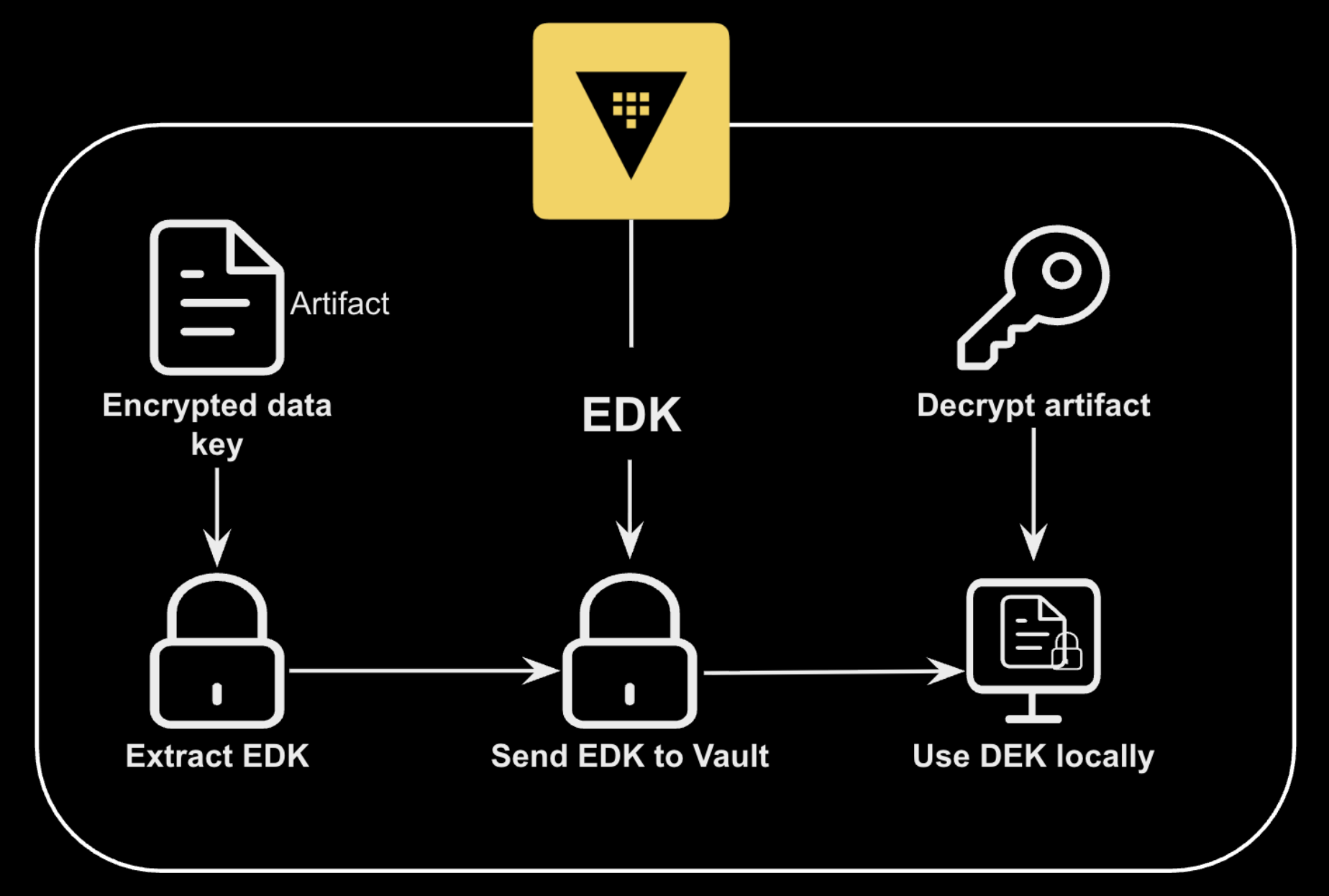
For decryption, the workflow is similarly straightforward:
- The client retrieves the encrypted artifact.
- The client extracts the EDK from the artifact.
- The EDK is sent to Vault Transit for decryption.
- If authenticated and authorized, Vault returns the decrypted DEK.
- The client uses this DEK locally to decrypt the original artifact.
Benefits of Envelope Encryption
Simplified Key Management
Envelope encryption significantly reduces the complexity associated with key management across distributed systems. Operators only need to manage a limited number of Transit keys in Vault instead of provisioning numerous application-level keys. Each artifact receives a temporary DEK used locally for data encryption while its encrypted version is stored alongside it. This centralizes governance in Vault while enhancing operational efficiency by minimizing large payload transfers for processing.
Flexible Policy Control
This new model allows operators to associate Transit keys with different policies in Vault, establishing clear security boundaries across various applications or environments. Since encrypted data keys travel with their corresponding artifacts, there’s no need for extensive key distribution between services. Access control remains centralized within Vault while applications handle local encryption tasks, streamlining secure workflow design without compromising efficiency.
Distributed Encryption at the Edge
By enabling local encryption and decryption within applications or services handling artifacts, envelope encryption distributes cryptographic computation across clients rather than centralizing it within Vault clusters. This architecture reduces network overhead by eliminating large payload transfers to Vault, thereby improving latency and throughput during data processing. The system supports substantial artifacts and streaming workloads effectively; prototypes have successfully handled artifacts up to 256 TB in size, with potential support extending up to 18 exabytes (264 bytes).
Crypto-Shredding Capabilities
A notable feature of envelope encryption is its support for crypto-shredding—a method that mitigates long-term data exposure risks. Since access to decrypted data relies on the associated Transit key protecting EDKs, removing or disabling this key renders encrypted artifacts permanently unreadable. This mechanism simplifies compliance with data retention regulations by allowing operators to manage sensitive data lifecycle through Transit key governance rather than locating every instance of sensitive information across distributed systems.
What This Means for Organizations
The introduction of envelope encryption through HashiCorp’s SDK marks a significant advancement in how organizations can manage sensitive data securely without sacrificing performance or scalability. By allowing local processing of large datasets while maintaining centralized cryptographic governance through Vault, organizations can efficiently protect high-throughput streams without facing traditional bottlenecks associated with centralized models. As industries increasingly rely on AI-driven workflows and massive datasets, this approach provides a practical foundation for securing modern workloads while ensuring compliance with stringent security standards.
For more information, read the original report here.







