

















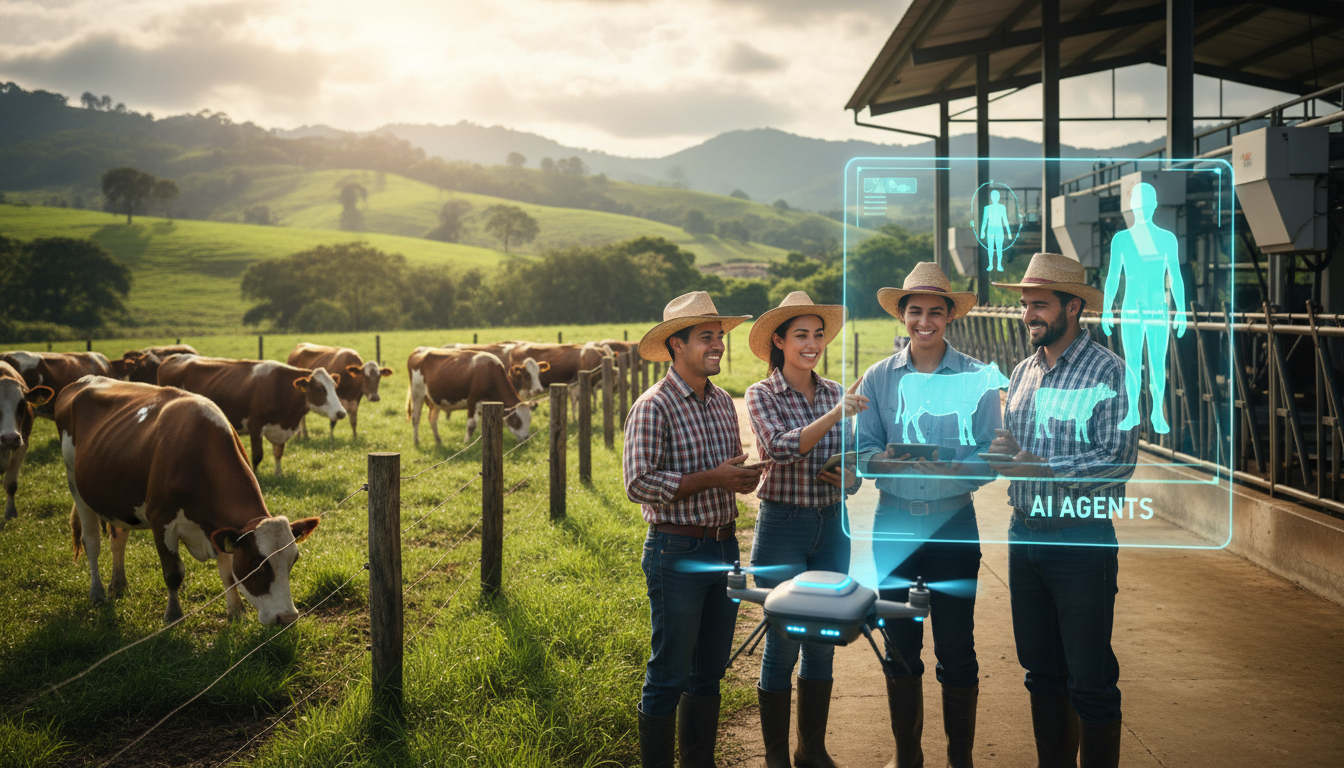
A Costa Rican dairy cooperative has begun deploying artificial intelligence agents as functional coworkers across its operations, marking one of Central America’s most ambitious experiments in workplace AI integration. The move signals how agricultural businesses outside major tech hubs are adopting agentic AI (AI systems that can autonomously perform tasks and make decisions) to handle everything from supply-chain logistics to member services.
From Tools to Teammates
The cooperative’s strategy reframes AI not as a back-office utility but as an active participant in daily workflows. Rather than using AI strictly for analytics dashboards or chatbots, the organisation has built specialised agents that take on defined roles, including processing supplier queries, monitoring milk-collection routes, and flagging anomalies in production data. Each agent operates with a scope similar to that of a human employee, complete with assigned responsibilities and access permissions.
This approach reflects a broader shift across enterprise technology, where companies are moving past generative AI’s chatbot phase toward systems that take action on a user’s behalf. For a dairy cooperative whose members are scattered across rural Costa Rica, the appeal is practical: AI agents can answer farmer questions in Spanish at any hour, route paperwork, and chase down information across multiple internal systems without waiting for human staff.
Why a Dairy Cooperative Bet on AI
Dairy cooperatives operate on thin margins and depend heavily on coordination between dozens or hundreds of small producers. Milk is perishable, transport windows are tight, and a single logistical error can mean spoiled product and lost revenue. Those pressures make the sector unexpectedly fertile ground for automation.
The cooperative’s leadership identified several recurring bottlenecks that AI agents could address:
- Repetitive member-service requests that consumed staff hours
- Manual reconciliation of milk volumes, quality tests, and payment calculations
- Slow internal communication between field operations and headquarters
- Difficulty surfacing insights buried in years of production records
By assigning each of these problem areas to a dedicated agent, the cooperative aims to free human employees for higher-value work such as veterinary support, sustainability planning, and member relationships, areas where empathy and physical presence still matter.
Building the Agent Workforce
Deploying AI agents in a cooperative environment is not a plug-and-play exercise. The organisation had to integrate large language models (the AI systems that power conversational assistants) with its existing enterprise resource planning software, member databases, and route-tracking tools. Without that integration, agents would be limited to general-purpose chat rather than actionable work.
Equally important was establishing guardrails. Agents must operate within defined permissions, escalate sensitive decisions to humans, and maintain audit trails so managers can review what was done and why. In a regulated industry like dairy, where food safety and traceability are non-negotiable, an unsupervised AI making autonomous changes to records would be a liability rather than an asset.
The cooperative also invested in training its human staff to work alongside the agents. Employees learned how to delegate tasks, validate agent outputs, and recognise when an agent’s confidence in its answer should be questioned. That human-in-the-loop model has become standard guidance from AI researchers studying real-world deployments.
Early Results and Lessons
While the cooperative has not published exhaustive metrics, early indicators point to faster response times for member inquiries and a measurable reduction in administrative backlog. Field staff report that they spend less time on phone calls and paperwork and more time visiting farms. The agents handle routine queries instantly, which in a rural cooperative context can be the difference between a producer getting same-day support and waiting until office hours.
Several lessons have emerged from the rollout:
- Domain context matters more than model size. A smaller model tuned to dairy-specific vocabulary and workflows outperformed larger general-purpose systems on member-facing tasks.
- Spanish-language performance required deliberate testing. Off-the-shelf models often default to English-centric responses, which would have alienated rural members.
- Trust is earned incrementally. Agents were introduced one workflow at a time, with humans reviewing outputs before each expansion of responsibility.
- Integration debt is real. Connecting agents to legacy systems consumed more engineering time than building the agents themselves.
A Template for Emerging Markets
The Costa Rican experiment carries implications well beyond a single cooperative. Much of the conversation around enterprise AI has centred on Fortune 500 companies in North America and Europe, leaving the impression that agentic systems require massive budgets and dedicated AI teams. The dairy cooperative’s deployment suggests otherwise.
Small and mid-sized organisations in agriculture, manufacturing, and services across Latin America, Africa, and Southeast Asia face similar pressures: limited administrative staff, geographically dispersed operations, and a need to serve users in local languages. AI agents, when scoped narrowly and integrated carefully, can address those needs without requiring the resources of a global enterprise.
Cloud providers have taken notice. Major platforms now offer pre-built agent frameworks and low-code tools that lower the technical barrier, allowing organisations with modest IT teams to assemble functional agent workflows in weeks rather than years.
What This Means
The cooperative’s deployment is a concrete example of AI agents leaving the demo stage and entering daily operations in places that rarely make tech headlines. For business leaders watching the agentic AI trend, the takeaway is that meaningful value comes from disciplined scoping, integration with existing systems, and ongoing human oversight, not from chasing the largest available model.
For workers, the shift raises familiar questions about how roles will evolve when digital colleagues handle routine tasks. The cooperative’s experience indicates that, at least so far, agents have absorbed administrative load rather than displacing field staff. Whether that balance holds as agent capabilities expand will be one of the defining workplace stories of the next several years. What is already clear is that the future of AI at work is being shaped not only in Silicon Valley boardrooms but also in dairy plants thousands of miles away.